Additive Binder Jets Market to Cross USD 16.0 billion by 2036
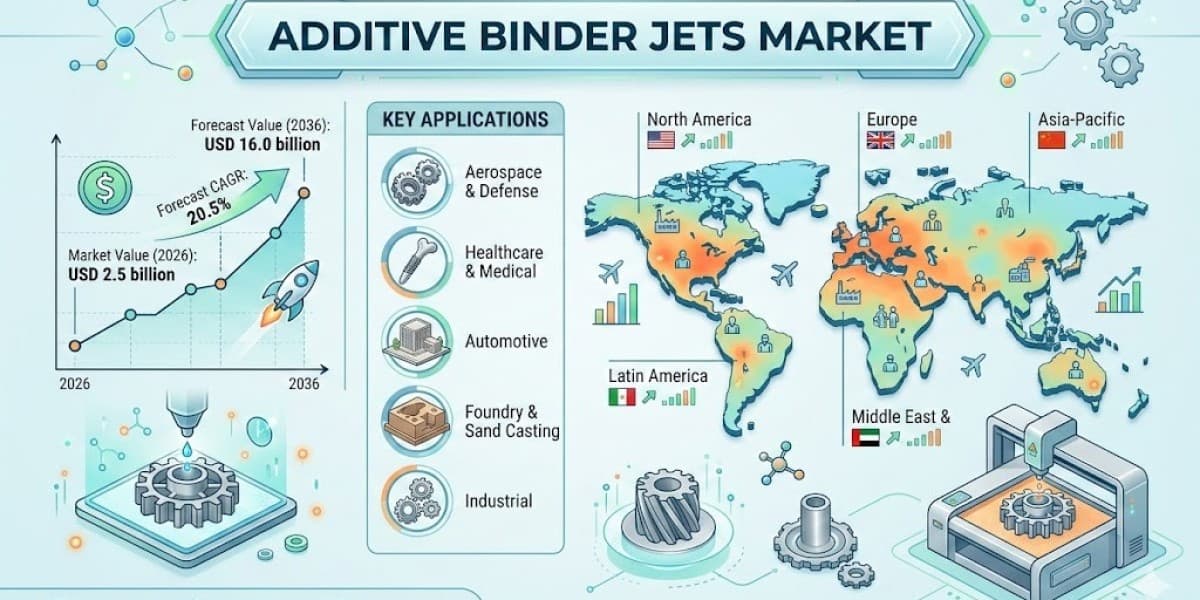
<p>The global <a href="https://www.futuremarketinsights.com/reports/additive-binder-jets-market">Additive Binder Jets Market</a> is witnessing accelerated momentum, projected to grow from USD 2.5 billion in 2026 to USD 16.0 billion by 2036, registering a CAGR of 20.5%. The growth reflects a decisive shift toward advanced manufacturing technologies that combine precision, efficiency, and scalability across aerospace, automotive, and industrial sectors.</p><p>Recent advancements in artificial intelligence and process automation have significantly improved production efficiency, reducing manufacturing time by nearly 35% while maintaining high dimensional accuracy. This positions binder jetting as a competitive alternative to traditional machining and casting processes.</p><p><strong>Request For Sample Report | Customize Report | Purchase Full Report–</strong><br /><a href="https://www.futuremarketinsights.com/reports/sample/rep-gb-31944">https://www.futuremarketinsights.com/reports/sample/rep-gb-31944</a></p><p><strong>Strong Market Growth Backed by Industrial Adoption</strong></p><p>The rapid transition of binder jetting from prototyping to full-scale production is a key growth driver. Industries are increasingly adopting the technology for its ability to produce complex geometries without tooling constraints.</p><p><strong>Key Growth Metrics:</strong></p><ul><li>Market value expected to reach <strong>USD 16.0 billion by 2036</strong></li><li><strong>20.5% CAGR</strong> between 2026 and 2036</li><li><strong>6X growth</strong> anticipated over the forecast period</li></ul><p>This growth is further supported by strategic partnerships between equipment manufacturers and material suppliers, accelerating commercialization and scalability.</p><p><strong>Key Drivers Accelerating Market Expansion</strong></p><p>Binder jetting adoption is driven by a combination of cost efficiency, sustainability, and operational flexibility.</p><p><strong>Major Growth Drivers:</strong></p><ul><li><strong>Reduced Production Costs:</strong> Eliminates tooling and minimizes labor-intensive processes</li><li><strong>High Material Efficiency:</strong> Up to <strong>95% powder utilization</strong> reduces waste</li><li><strong>Faster Time-to-Market:</strong> Production cycles reduced from weeks to days</li><li><strong>Design Innovation:</strong> Enables complex and lightweight component manufacturing</li><li><strong>Supply Chain Optimization:</strong> Supports localized and on-demand production</li></ul><p>These advantages make binder jetting highly attractive for industries seeking efficiency and resilience.</p><p><strong>Material Advancements Unlock New Opportunities</strong></p><p>Material innovation is expanding the scope of binder jetting applications beyond traditional metals.</p><p><strong>Material Trends:</strong></p><ul><li>Expansion into <strong>titanium and aluminum processing</strong></li><li>Growing adoption of <strong>ceramics and composite materials</strong></li><li>Continued dominance of <strong>metal applications (over 68% share)</strong></li></ul><p>These developments are enabling high-performance applications in aerospace, automotive, and energy sectors.</p><p><strong>Regional Insights Highlight Growth Hotspots</strong></p><p>Global expansion of binder jetting reflects varying industrial priorities and investment strategies.</p><p><strong>Regional Highlights:</strong></p><ul><li><strong>Asia Pacific:</strong> Fastest-growing region with <strong>22.0% CAGR</strong></li><li><strong>Europe:</strong> Strong growth at <strong>20.0% CAGR</strong>, driven by automotive innovation</li><li><strong>North America:</strong> Stable growth at <strong>19.5% CAGR</strong>, led by aerospace and defense</li></ul><p>The United States leads the global market, accounting for a significant share due to strong R&D investments and advanced manufacturing infrastructure.</p><p><strong>Emerging Trends Transforming the Industry</strong></p><p>The evolution of binder jetting is being shaped by digital transformation and sustainability initiatives.</p><p><strong>Key Trends:</strong></p><ul><li><strong>AI Integration:</strong> Real-time monitoring and predictive maintenance</li><li><strong>Multi-Material Printing:</strong> Enhanced functionality and performance</li><li><strong>Software Optimization:</strong> Simulation tools reduce development cycles</li><li><strong>Sustainable Manufacturing:</strong> Reduced waste and energy consumption</li><li><strong>Distributed Production:</strong> Decentralized manufacturing models</li></ul><p>These trends are expected to further enhance efficiency and drive widespread adoption.</p><p><strong>Competitive Landscape and Strategic Developments</strong></p><p>The market is highly competitive, with leading players focusing on innovation, partnerships, and vertical integration.</p><p><strong>Recent Developments:</strong></p><ul><li>Strategic collaborations to advance metal additive manufacturing</li><li>Launch of advanced binder jet systems with improved material compatibility</li><li>Increased R&D investments to enhance process efficiency</li></ul><p>Companies are also expanding service capabilities to support end-users with implementation and optimization.</p>