Air Compressor Filters Market Report Confirms USD 3,637.8 million by 2035
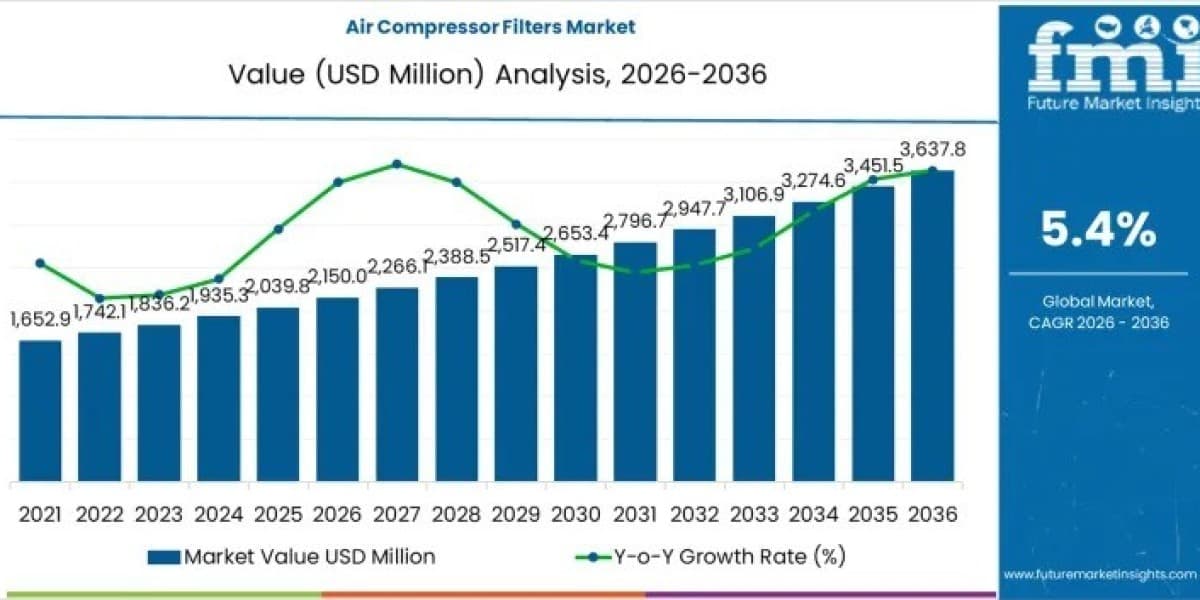
<p>The <a href="https://www.futuremarketinsights.com/reports/air-compressor-filters-market"><strong>Air Compressor Filters Market</strong></a> is projected to grow from <strong>USD 2,150.0 million in 2026</strong> to <strong>USD 3,637.8 million by 2036</strong>, registering a <strong>CAGR of 5.4%</strong> during the forecast period. Market expansion is increasingly shaped by operational efficiency, replacement economics, and lifecycle value rather than aggressive shipment growth.</p><p>Compressed air systems are among the most energy-intensive utilities in industrial operations. Even small inefficiencies caused by poor filtration directly translate into higher power consumption and operating costs. As a result, end users are prioritizing filters that deliver <strong>lower pressure drop, longer service intervals, and stable performance</strong>, enabling suppliers to maintain pricing power through measurable value delivery.</p><p><strong>Subscribe for Year-Round Insights → Stay ahead with quarterly and annual data updates:</strong><br /><a href="https://www.futuremarketinsights.com/reports/sample/rep-gb-30975">https://www.futuremarketinsights.com/reports/sample/rep-gb-30975</a></p><p><strong>Key Market Metrics at a Glance</strong></p><ul><li><strong>Market Value (2026):</strong> USD 2,150.0 Million</li><li><strong>Forecast Value (2036):</strong> USD 3,637.8 Million</li><li><strong>Forecast CAGR (2026–2036):</strong> 5.40%</li><li><strong>Leading Compressor Type:</strong> Rotary Screw</li><li><strong>Largest End Use:</strong> Manufacturing</li><li><strong>Key Growth Regions:</strong> Asia Pacific, North America, Middle East & Africa</li></ul><p><strong>Why Energy Efficiency Is Reshaping Filter Demand</strong></p><p>Energy efficiency has emerged as a decisive purchasing factor across industrial filtration systems. Pressure loss caused by clogged or low-quality filters leads to higher compressor workload and increased electricity costs. This has shifted buyer focus toward high-performance filter media and advanced pleating designs.</p><p>Key efficiency-driven trends include:</p><ul><li>Adoption of <strong>high-efficiency coalescing and particulate filters</strong></li><li>Demand for <strong>extended replacement intervals</strong></li><li>Increased evaluation of <strong>total cost of ownership (TCO)</strong> rather than unit price</li><li>Preference for filters validated for <strong>OEM performance standards</strong></li></ul><p><strong>Buyer Behavior: Risk Aversion and Vendor Lock-In</strong></p><p>Industrial buyers exhibit strong risk aversion when selecting air compressor filters. Filtration failure can result in:</p><ul><li>Equipment damage</li><li>Production downtime</li><li>Product contamination</li><li>Regulatory non-compliance</li></ul><p>As a result, OEM-specified and certified aftermarket filters dominate purchasing decisions. This behavior reinforces <strong>vendor lock-in</strong>, raises switching costs, and concentrates margins among suppliers capable of guaranteeing reliability and performance assurance. Between 2026 and 2036, value capture is expected to favor companies monetizing <strong>replacement cycles, preventive maintenance programs, and energy savings</strong> rather than volume-based pricing strategies.</p><p><strong>Segment Analysis: Continuous-Duty Applications Drive Demand</strong></p><p><strong>Rotary screw compressors</strong> account for approximately <strong>56% of market demand</strong>, reflecting their widespread use in continuous-operation industrial environments. These compressors generate high airflow volumes and require multi-stage filtration systems, including intake, oil, and air-oil separator filters, leading to higher filter consumption.</p><p>From an end-use perspective, <strong>manufacturing represents nearly 34% of total demand</strong>, supported by:</p><ul><li>Heavy use of pneumatic tools and automation</li><li>High sensitivity to air contamination</li><li>Strong emphasis on equipment uptime and product quality</li></ul><p>Industries such as automotive, electronics, food processing, and general manufacturing continue to reinforce recurring demand through scheduled filter replacement practices.</p><p><strong>Technology Advancements Supporting Market Expansion</strong></p><p>Technological innovation remains central to market competitiveness. Suppliers are investing in:</p><ul><li>Advanced filter media with <strong>higher dust-holding capacity</strong></li><li>Designs optimized for <strong>minimal pressure loss</strong></li><li>Modular filter systems for <strong>ease of replacement</strong></li><li>Solutions aligned with <strong>oil-free and high-pressure compressors</strong></li></ul><p>Preventive maintenance adoption is also strengthening recurring demand, as industrial users increasingly follow structured replacement schedules to avoid unplanned shutdowns and efficiency losses.</p><p><strong>Regional Growth Outlook: Emerging Markets Lead Momentum</strong></p><p>The market shows strong regional momentum across industrializing economies:</p><ul><li><strong>India (6.8% CAGR):</strong> Manufacturing expansion, dust-heavy environments, and preventive maintenance adoption</li><li><strong>Vietnam (6.4% CAGR):</strong> Export-oriented manufacturing and humidity-driven filtration needs</li><li><strong>Indonesia (6.1% CAGR):</strong> Growth in heavy industry, mining, and infrastructure</li><li><strong>Mexico (5.7% CAGR):</strong> Automotive and electronics manufacturing growth</li><li><strong>Saudi Arabia (5.2% CAGR):</strong> Harsh operating conditions across oil & gas and construction sectors</li></ul><p><strong>Competitive Landscape: Performance and Lifecycle Value Take Priority</strong></p><p>Competition in the air compressor filters market is defined by filtration efficiency, service life, and compatibility across compressor platforms. Leading players include:</p><ul><li>Atlas Copco</li><li>Ingersoll Rand</li><li>Donaldson Company</li><li>Parker Hannifin</li><li>MANN+HUMMEL</li><li>Sullair (Hitachi)</li><li>Kaeser Kompressoren</li><li>CompAir (Gardner Denver)</li><li>FS-Curtis</li></ul><p>OEM-integrated suppliers benefit from validated system compatibility, while filtration specialists differentiate through media innovation and cross-platform adaptability. Regional aftermarket brands compete on availability and pricing but face increasing pressure to match performance benchmarks.</p><p><strong>Market Outlook: Stable, Replacement-Led Growth Ahead</strong></p><p>The air compressor filters market is expected to maintain <strong>steady, value-led growth through 2036</strong>, supported by energy efficiency priorities, preventive maintenance strategies, and expanding industrial automation. Filters are increasingly viewed as strategic components that protect assets, control costs, and sustain production reliability.</p>