Barcode Scanner Market Report Confirms USD 15.8 billion by 2035
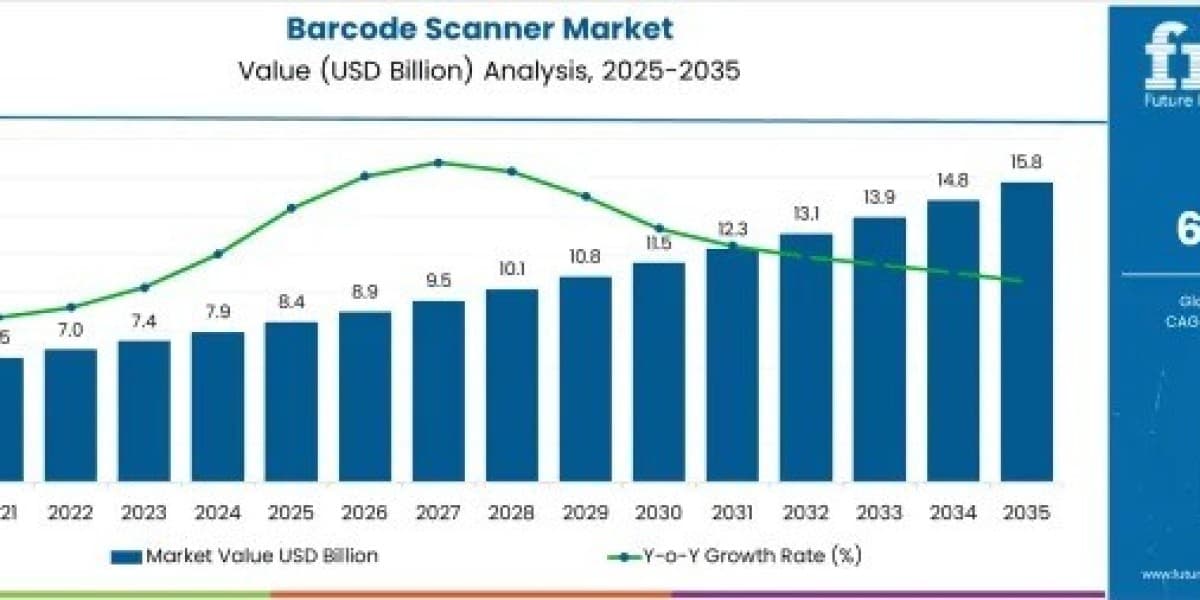
<p>The <a href="https://www.futuremarketinsights.com/reports/barcode-scanner-market">Barcode Scanner Market</a> is on a stable growth trajectory, expanding at a CAGR of 6.5% between 2025 and 2035. Rising demand for automated data capture, coupled with digital transformation initiatives across retail, logistics, healthcare, and manufacturing, is reinforcing long-term market confidence.</p><p><strong>Key Market Numbers</strong></p><ul><li>Market value (2025): USD 8.4 billion</li><li>Forecast value (2035): USD 15.8 billion</li><li>Absolute opportunity: USD 7.4 billion</li><li>Market expansion: ~1.9x over ten years</li></ul><p>This growth reflects the essential role of barcode scanners in improving data accuracy, reducing manual errors, and supporting high-volume operations.</p><p><strong>Subscribe for Year-Round Insights → Stay ahead with quarterly and annual data updates: </strong><a href="https://www.futuremarketinsights.com/reports/sample/rep-gb-2871">https://www.futuremarketinsights.com/reports/sample/rep-gb-2871</a></p><p><strong>Growth Momentum by Phase: Where Value Is Being Created</strong></p><p><strong>2025–2030: Foundation Growth Phase</strong></p><ul><li>Market expands from USD 8.4 billion to USD 11.6 billion</li><li>Accounts for 43.2% of total forecast growth</li><li>Driven by:</li><ul><li>Retail checkout automation</li><li>Warehouse modernization</li><li>Adoption of wireless and mobile scanning devices</li><li>Integration with cloud-based inventory platforms</li></ul></ul><p><strong>2030–2035: Acceleration and Specialization Phase</strong></p><ul><li>Market grows from USD 11.6 billion to USD 15.8 billion</li><li>Contributes 56.8% of decade growth</li><li>Characterized by:</li><ul><li>RFID-enabled and industry-specific scanners</li><li>IoT and enterprise software integration</li><li>Customized solutions for healthcare, aviation, and manufacturing</li></ul></ul><p><strong>Why the Barcode Scanner Market Is Growing</strong></p><p>The market’s expansion is anchored in measurable operational outcomes rather than discretionary technology spending.</p><p><strong>Core Growth Drivers</strong></p><ul><li>95–99% improvement in data capture accuracy versus manual entry</li><li>Rising e-commerce volumes increasing demand for error-free fulfillment</li><li>Supply chain visibility becoming a strategic priority</li><li>Government-led digitalization programs in retail and manufacturing</li></ul><p><strong>Adoption Challenges</strong></p><ul><li>High upfront investment for advanced scanning systems</li><li>Integration complexity with legacy IT infrastructure</li><li>Ongoing technical support and training requirements</li></ul><p>Despite these barriers, the return on accuracy and efficiency continues to justify adoption.</p><p><strong>Segment Highlights: Clear Leaders Across Categories</strong></p><p><strong>By Product Type</strong></p><ul><li><strong>Portable/Handheld scanners</strong></li><ul><li>~70% market share in 2025</li><li>Preferred for mobility, flexibility, and wireless connectivity</li><li>Widely used in retail floors, warehouses, and healthcare settings</li></ul><li><strong>Fixed-position scanners</strong></li><ul><li>Used in high-volume, automated environments</li><li>Strong presence in manufacturing and logistics hubs</li></ul></ul><p><strong>By End User</strong></p><ul><li><strong>Retail & Commercial</strong></li><ul><li>~35% market share</li><li>Driven by POS automation and real-time inventory needs</li></ul><li><strong>Logistics & Warehousing</strong></li><ul><li>Rapid adoption due to e-commerce growth</li><li>Focus on speed, accuracy, and throughput</li></ul><li><strong>Healthcare and Manufacturing</strong></li><ul><li>Growing demand for asset tracking, compliance, and traceability</li></ul></ul><p><strong>Technology Trends Reshaping the Market</strong></p><ul><li><strong>Laser scanners</strong></li><ul><li>Strong adoption due to reliability and cost efficiency</li></ul><li><strong>Camera-based scanners</strong></li><ul><li>Gaining traction for damaged or multi-dimensional codes</li></ul><li><strong>RFID-enabled systems</strong></li><ul><li>Expanding in advanced tracking and automation use cases</li></ul><li><strong>Smartphone-based scanners</strong></li><ul><li>Emerging as flexible, low-cost alternatives in select applications</li></ul></ul><p>Technology differentiation is increasingly centered on integration, durability, and multi-functionality.</p><p><strong>Regional Outlook: Growth Anchored by Mature and Emerging Economies</strong></p><p><strong>High-Growth Regions</strong></p><ul><li>North America: Retail automation and warehouse digitization leadership</li><li>East Asia: Manufacturing digitization and e-commerce scale</li><li>Western Europe: Industry 4.0 and logistics modernization</li></ul><p><strong>Country-Level Momentum</strong></p><ul><li>United States: CAGR ~7%, driven by advanced retail and logistics ecosystems</li><li>China: CAGR ~6.8%, supported by e-commerce and industrial automation</li><li>Germany, Japan, India: Stable growth through efficiency-driven adoption</li></ul><p><strong>Competitive Landscape: Innovation Over Price Competition</strong></p><p>The market includes around 20–25 meaningful players, with the top three controlling approximately 35–40% of global share.</p><p><strong>Leading Companies</strong></p><ul><li>Honeywell International Inc.</li><li>Zebra Technologies Corporation</li><li>Datalogic S.p.A.</li></ul><p>Competition focuses on:</p><ul><li>Product reliability and lifecycle performance</li><li>Software and system integration capabilities</li><li>Industry-specific customization</li></ul><p>Regional players are gaining ground in Asia and Latin America through localized support and rapid customization.</p>