Bridge Bearing Market to Cross USD 3,099.4 million by 2036
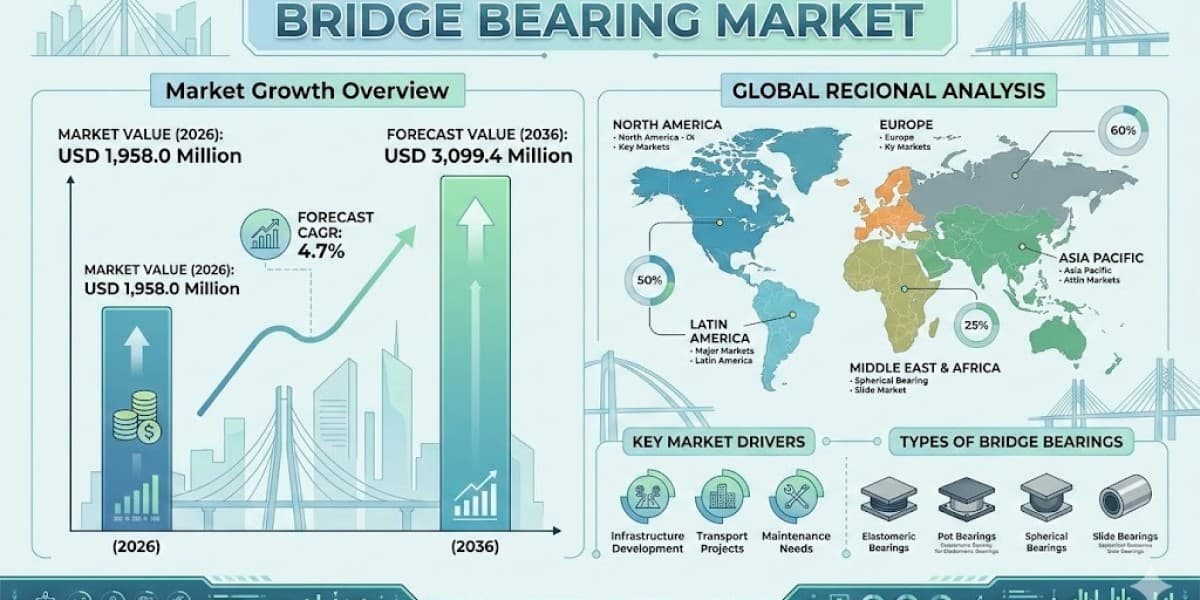
<p>The global <a href="https://www.futuremarketinsights.com/reports/bridge-bearings-market">Bridge Bearing Market</a> is witnessing steady expansion, projected to grow from USD 1,958.0 million in 2026 to USD 3,099.4 million by 2036, reflecting a CAGR of 4.7%. This growth trajectory is strongly supported by increasing infrastructure rehabilitation programs in developed regions and large-scale bridge construction projects across emerging economies.</p><p>The market is evolving as governments and private stakeholders prioritize long-term durability, safety, and compliance with modern engineering standards. Aging bridge networks, particularly in North America and Europe, are driving significant replacement demand, while Asia-Pacific continues to lead in new infrastructure development.</p><p><strong>Request For Sample Report | Customize Report | Purchase Full Report–</strong><br /><a href="https://www.futuremarketinsights.com/reports/sample/rep-gb-4955">https://www.futuremarketinsights.com/reports/sample/rep-gb-4955</a></p><p><strong>Market Overview and Growth Dynamics</strong></p><p>The bridge bearing market is benefiting from a combination of structural and economic factors. Increasing urbanization, population growth, and the need for efficient transportation networks are pushing governments to invest heavily in bridge construction and maintenance.</p><p><strong>Key Growth Drivers:</strong></p><ul><li>Rising global urban population expected to add 1.5 billion people by 2030</li><li>Nearly 42% of bridges in the U.S. are over 50 years old</li><li>Strong government funding across the U.S., EU, China, and India</li><li>Growing demand for durable and maintenance-free infrastructure components</li></ul><p>These factors collectively ensure consistent demand for bridge bearing systems across both developed and developing economies.</p><p><strong>Transition Toward Performance-Based Engineering</strong></p><p>A major shift in the industry is the move from prescriptive specifications to performance-based design standards. This transition is enabling engineers to select bearing systems based on real-world performance metrics rather than traditional design limitations.</p><p><strong>Emerging Design Priorities:</strong></p><ul><li>Seismic isolation and vibration control</li><li>Extended service life with minimal maintenance</li><li>Compliance with updated infrastructure codes</li><li>Enhanced load distribution capabilities</li></ul><p>This trend is particularly significant in earthquake-prone regions, where advanced bearing systems are essential for structural resilience.</p><p><strong>Segment Analysis: Leading Investment Areas</strong></p><p>The market demonstrates strong segmentation across bearing types and materials, with specific segments leading in adoption due to cost efficiency and performance advantages.</p><p><strong>Top Segments by Share:</strong></p><ul><li>Elastomeric Bearings: ~41.9% market share (2025)</li><ul><li>Low maintenance and cost-effective</li><li>Widely used in both new and existing bridges</li></ul><li>Steel Bearings: ~56.6% share by material type</li><ul><li>High strength and durability</li><li>Suitable for heavy-load infrastructure projects</li></ul></ul><p>These segments highlight the industry’s focus on balancing affordability with high-performance requirements.</p><p><strong>Regional Insights: Growth Across Key Economies</strong></p><p>Global demand for bridge bearings varies significantly across regions, driven by infrastructure maturity and investment levels.</p><p><strong>Country-Level Growth Trends (2026–2036 CAGR):</strong></p><ul><li>China: 5.6% (largest producer and consumer)</li><li>India: 5.3% (rapid infrastructure expansion)</li><li>Japan: 5.9% (high seismic demand)</li><li>Germany: 3.8% (steady infrastructure upgrades)</li><li>United States: 2.6% (rehabilitation-driven demand)</li></ul><p>Asia-Pacific remains the fastest-growing region, supported by massive infrastructure programs and increasing urban connectivity needs.</p><p><strong>Seismic Safety and Environmental Considerations</strong></p><p>Seismic risks and environmental challenges are reshaping the bridge bearing market. Advanced bearing technologies are being designed to handle dynamic loads, temperature variations, and natural disasters.</p><p><strong>Key Trends:</strong></p><ul><li>Increasing adoption of seismic isolation bearings</li><li>Rising demand in earthquake-prone regions such as Japan and California</li><li>Focus on climate-resilient infrastructure design</li><li>Integration of advanced materials for improved durability</li></ul><p>These innovations are critical for ensuring long-term structural integrity and public safety.</p><p><strong>Competitive Landscape and Industry Developments</strong></p><p>The market is moderately consolidated, with Tier 1 players accounting for 50–60% of global share. Leading companies are investing in innovation, partnerships, and geographic expansion.</p><p><strong>Recent Industry Highlights:</strong></p><ul><li>Freyssinet executed a major bridge rehabilitation project in Puerto Rico</li><li>MAURER SE supplied spherical bearings for European bridge construction</li><li>Tata Steel aligned its growth strategy with infrastructure demand</li></ul><p><strong>Key Market Players Include:</strong></p><ul><li>Trelleborg AB</li><li>Canam Group Inc.</li><li>Ekspan Ltd.</li><li>Epic Polymer Systems Corp.</li><li>Mageba SA</li></ul><p>These companies are driving advancements in bearing technology and expanding their global footprint.</p>