Corn-Based Plastics for Packaging Market to Reach USD 3.42 Billion by 2036
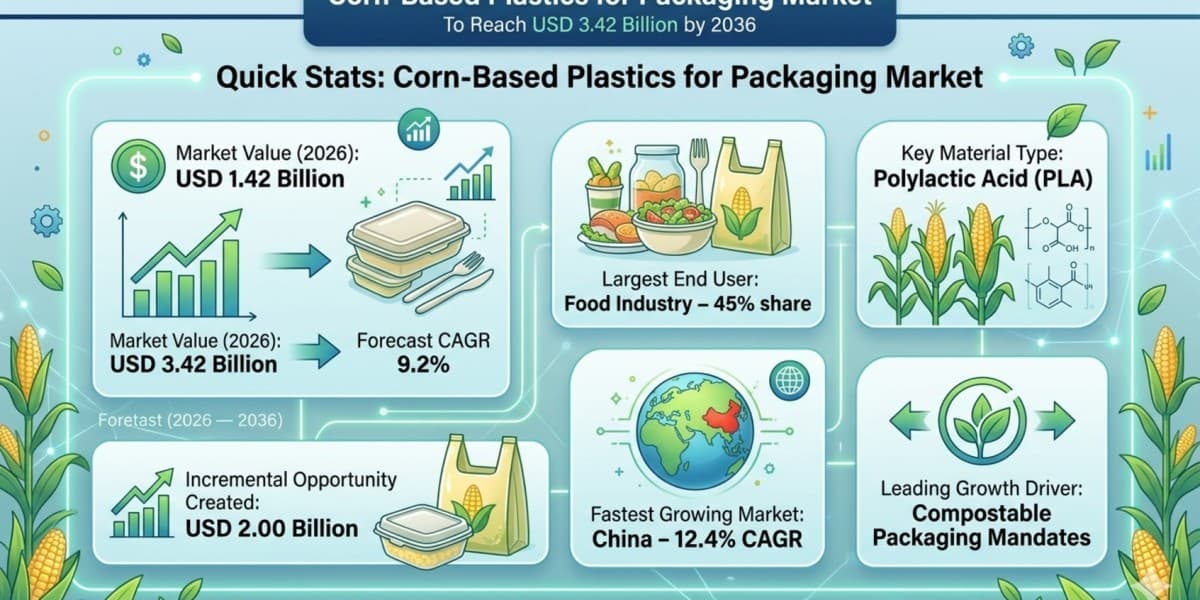
<p>The global corn-based plastics for packaging market is projected to grow from USD 1.42 billion in 2026 to USD 3.42 billion by 2036, registering a compound annual growth rate (CAGR) of 9.2% during the forecast period. Growth is being fueled by accelerating bans on conventional single-use plastics, rising adoption of compostable packaging materials, and expanding PLA resin production capacities across major global markets.</p><p> </p><p><strong>Quick Stats: Corn-Based Plastics for Packaging Market</strong></p><ul><li>Market Value (2026): USD 1.42 Billion<br />• Forecast Value (2036): USD 3.42 Billion<br />• Forecast CAGR (2026–2036): 9.2%<br />• Largest End User: Food Industry – 45% share<br />• Incremental Opportunity Created: USD 2.00 Billion<br />• Fastest Growing Market: China – 12.4% CAGR<br />• Key Material Type: Polylactic Acid (PLA)<br />• Leading Growth Driver: Compostable Packaging Mandates</li></ul><p> </p><p>Corn-based plastics are emerging as a key bio-based alternative to petroleum-derived packaging materials, particularly across food service, retail, agricultural, and pharmaceutical packaging applications.</p><p>Growing consumer awareness surrounding plastic pollution, combined with aggressive sustainability targets from governments and multinational brands, is accelerating the transition toward biodegradable and compostable packaging systems.</p><p>The market is increasingly becoming regulation-driven, where compliance with compostability standards, food-contact certifications, and municipal packaging waste mandates directly influences procurement decisions across global supply chains.</p><p> </p><p><strong>Market Share Across Sustainable Packaging Ecosystem</strong></p><ul><li>Compostable Packaging Market: ~18–21% share<br />• Bio-Based Packaging Materials Segment: ~14–17% share<br />• Sustainable Food Service Packaging Market: ~16–19% share<br />• Bioplastics Industry: ~10–12% share<br />• Eco-Friendly Flexible Packaging Segment: ~8–10% share</li></ul><p>These figures highlight the growing strategic importance of PLA-based packaging within the global transition toward circular economy and low-carbon packaging solutions.</p><p> </p><p><strong>Key Growth Drivers</strong></p><ul><li>Single-Use Plastic Ban Enforcement: Government restrictions on petroleum-based plastics are accelerating adoption of compostable alternatives.</li><li>Food Service Packaging Transformation: Quick-service restaurants and retail chains are increasingly shifting toward PLA-based containers, wraps, and cutlery.</li><li>Consumer Sustainability Preferences: Rising demand for eco-friendly and biodegradable packaging is influencing purchasing decisions globally.</li><li>PLA Production Capacity Expansion: Increased corn starch-to-PLA resin production in China and the United States is improving availability and reducing pricing pressure.</li></ul><p> </p><p><strong>Technological Advancements & Supply Chain Innovation</strong></p><p>The market is witnessing rapid innovation across bio-polymer processing and sustainable packaging manufacturing:</p><ul><li>Advanced PLA thermoforming technologies improving durability and flexibility</li><li>High-barrier bio-based packaging films enhancing food shelf life</li><li>Industrial compostability certification systems improving regulatory acceptance</li><li>Improved resin blending techniques enhancing heat resistance and performance</li></ul><p>Manufacturers are also integrating closed-loop recycling and industrial composting partnerships to strengthen sustainable packaging ecosystems globally.</p><p> </p><p><strong>Product Innovation Trends</strong></p><p>Companies are expanding product portfolios through:</p><ul><li>Compostable food containers and takeaway packaging</li><li>PLA-based wraps and flexible packaging films</li><li>Biodegradable agricultural mulch films</li><li>Sustainable pharmaceutical blister packaging</li><li>Lightweight high-strength corn-based packaging materials</li></ul><p>These innovations are supporting broader adoption across food retail, healthcare, agriculture, and consumer goods industries.</p><p> </p><p><strong>Pricing and Market Stability</strong></p><p>The market continues to experience moderate price stabilization as production capacities scale globally:</p><ul><li>PLA resin packaging grades: ~USD 2,200–3,000 per metric ton</li><li>Compostable food packaging products: Premium pricing of 15–30% over conventional plastics depending on certification standards</li></ul><p>Improving economies of scale and increasing institutional procurement are expected to narrow the cost gap between bio-based and petroleum-derived plastics over the forecast period.</p><p> </p><p>? Get Access to the Report Sample: <a href="https://www.futuremarketinsights.com/reports/sample/rep-gb-5423">https://www.futuremarketinsights.com/reports/sample/rep-gb-5423</a></p><p> </p><p><strong>Regional Outlook</strong></p><p>China leads the market growth trajectory with a projected CAGR of 12.4%, supported by aggressive plastics pollution regulations and large-scale PLA production investments.</p><p>India follows with 11.5% CAGR due to expanding food packaging demand and implementation of single-use plastic bans across multiple states.</p><p>Europe remains a major high-value market driven by strict packaging waste directives, compostability standards, and mature industrial composting infrastructure.</p><p>North America continues to witness strong growth through retail sustainability commitments and food service packaging mandates.</p><p> </p><p><strong>Country-Wise CAGR Snapshot</strong></p><ul><li>China: 12.4%<br />• India: 11.5%<br />• Germany: 10.6%<br />• Brazil: 9.7%<br />• USA: 8.7%<br />• UK: 7.8%<br />• Japan: 6.9%</li></ul><p> </p><p><strong>Segment Highlights</strong></p><p><strong>By End User</strong></p><p>The food industry is projected to dominate the market with 45% share in 2026, supported by rising adoption of compostable food packaging, fresh produce containers, takeaway packaging, and sustainable food wraps.</p><p>Food manufacturers and restaurant chains are increasingly replacing conventional plastics with PLA-based alternatives to meet evolving sustainability commitments and regulatory requirements.</p><p> </p><p><strong>Competitive Landscape</strong></p><p>Competition is increasingly shaped by production scalability, compostability certifications, processing expertise, and supply chain reliability.</p><p>Key companies operating in the market include:</p><ul><li>CornWare<br />• NatureWorks<br />• Klockner Pentaplast<br />• Braskem<br />• Novamont<br />• BASF<br />• Corbion<br />• PSM<br />• DuPont<br />• Arkema<br />• Kingfa<br />• FKuR<br />• Biomer<br />• Mitsubishi</li></ul><p> </p><p><strong>Future Outlook</strong></p><p>The corn-based plastics for packaging market is expected to witness strong long-term expansion as sustainability transitions accelerate across packaging industries worldwide.</p><p>Future growth will be supported by:</p><ul><li>Expansion of industrial composting infrastructure<br />• Increasing regulatory enforcement against single-use plastics<br />• Growth in sustainable food packaging demand<br />• Rising investments in PLA resin manufacturing capacity<br />• Advancements in biodegradable polymer engineering</li></ul><p>As governments, retailers, and consumers increasingly prioritize circular packaging solutions, corn-based plastics are expected to become a core pillar of the global sustainable packaging economy.</p><p> </p><p><strong>About the Market</strong></p><p>Corn-based plastics for packaging are bio-derived polymer materials, primarily polylactic acid (PLA), manufactured through fermentation and polymerization of corn starch sugars. These materials serve as compostable alternatives to petroleum-based plastics across food packaging, agricultural films, pharmaceutical packaging, and consumer goods applications.</p><p> </p><p><strong>About Future Market Insights (FMI)</strong></p><p>Future Market Insights (FMI) is a leading market intelligence and consulting firm delivering actionable insights across packaging, sustainability, manufacturing, healthcare, food & beverage, and industrial sectors.</p><p>Serving clients in more than 150 countries, FMI provides custom research, syndicated reports, and strategic consulting solutions to help organizations navigate evolving global market dynamics.</p>