Pallet Pooling Market Toward USD 15.4 billion by 2035
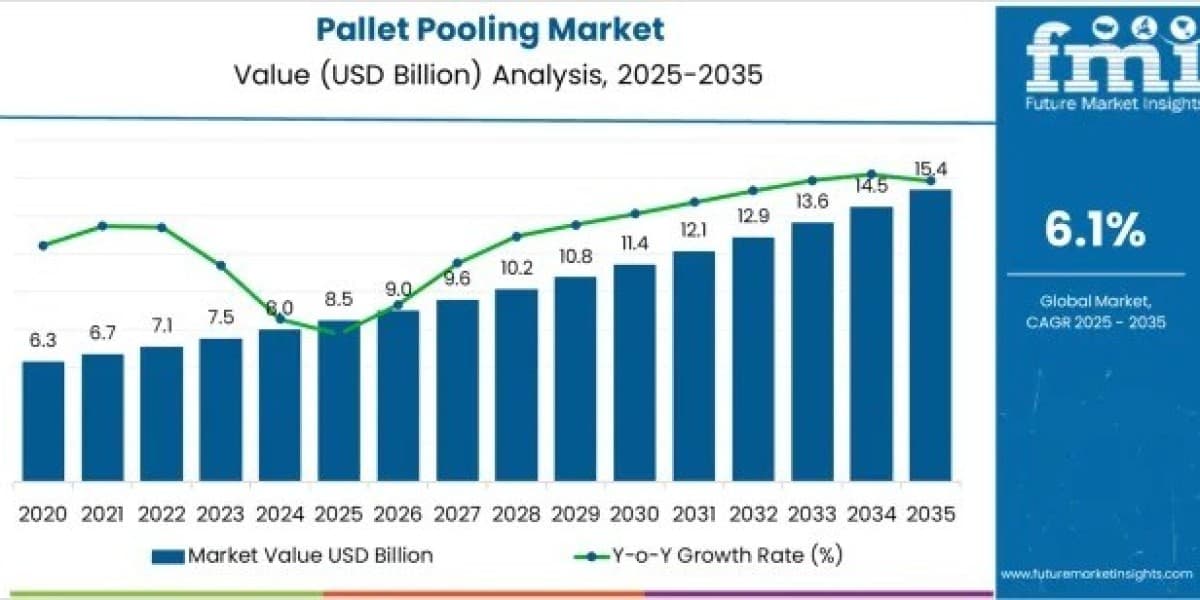
<p>The global <a href="https://www.futuremarketinsights.com/reports/pallet-pooling-market"><strong>Pallet Pooling Market</strong></a> is witnessing sustained expansion, supported by rising global trade volumes, growing emphasis on supply chain efficiency, and increasing adoption of sustainable logistics solutions. Valued at <strong>USD 8.5 billion in 2025</strong>, the market is forecast to reach <strong>USD 15.4 billion by 2035</strong>, registering a <strong>CAGR of 6.1%</strong> over the forecast period.</p><p>The transition from pallet ownership to rental-based pooling systems is reshaping logistics economics. Businesses across manufacturing, retail, and FMCG sectors are prioritizing pooled pallets to improve asset utilization, lower capital expenditure, and ensure consistent load handling across complex distribution networks.</p><p><strong>Request For Sample Report | Customize Report | Purchase Full Report –</strong><br /><a href="https://www.futuremarketinsights.com/reports/sample/rep-gb-3671">https://www.futuremarketinsights.com/reports/sample/rep-gb-3671</a></p><p><strong>Market Size, Share, and Performance Highlights</strong></p><p>The pallet pooling market’s growth trajectory reflects both operational and environmental priorities across industries.</p><p><strong>Key market indicators include:</strong></p><ul><li>Market value of <strong>USD 8.5 billion in 2025</strong>, expanding to <strong>USD 15.4 billion by 2035</strong></li><li>Forecast <strong>CAGR of 6.1%</strong> from 2025 to 2035</li><li>Strong demand from industries requiring high pallet turnaround and standardized logistics</li><li>Increased integration of reusable assets aligned with circular economy principles</li></ul><p>Rising automation in warehouses and distribution centers is strengthening demand for standardized, high-quality pallets compatible with robotic handling and conveyor-based systems.</p><p><strong>Structural Design Insights: Block Pallets Lead Adoption</strong></p><p>Block pallets represent the dominant structural design, accounting for <strong>47.3% of the market in 2025</strong>. Their four-way entry access, superior load-bearing capacity, and compatibility with automated material handling systems support widespread adoption.</p><p><strong>Key advantages driving block pallet demand:</strong></p><ul><li>Enhanced stability for high-load and high-speed logistics operations</li><li>Improved stacking efficiency and storage optimization</li><li>Extended service life, lowering long-term operational costs</li></ul><p>As automation penetration increases globally, block pallets are expected to maintain leadership within pallet pooling networks.</p><p><strong>Materials Analysis: Plastic Pallets Gain Strategic Importance</strong></p><p>By material, plastic pallets hold a <strong>39.8% share</strong>, driven by hygiene, durability, and consistency requirements across regulated industries.</p><p><strong>Growth drivers for plastic pallets include:</strong></p><ul><li>Resistance to moisture, contamination, and microbial growth</li><li>Lightweight design reducing transportation costs</li><li>Compatibility with RFID and barcode-based tracking systems</li><li>Closed-loop recyclability supporting sustainability targets</li></ul><p>Food, pharmaceutical, and chemical supply chains continue to favor plastic pallets for high-frequency pooling operations.</p><p><strong>End-Use Industry Trends: Food & Beverages at the Forefront</strong></p><p>The food and beverages sector accounts for <strong>42.6% of pallet pooling demand</strong>, reflecting stringent hygiene regulations and continuous product movement.</p><p><strong>Factors reinforcing adoption in this segment:</strong></p><ul><li>High turnover of perishable and packaged goods</li><li>Need for standardized pallets across temperature-controlled logistics</li><li>Growing focus on traceability, compliance, and sustainability</li></ul><p>As global consumption of processed and packaged foods rises, this segment is expected to generate consistent utilization and revenue growth.</p><p><strong>Regional Outlook: Emerging Markets Drive Future Growth</strong></p><p>Regional performance highlights uneven but strong growth dynamics.</p><p><strong>Forecast growth trends include:</strong></p><ul><li>United States and United Kingdom expanding at <strong>4.7% CAGR</strong>, driven by e-commerce and efficiency-focused logistics</li><li>Germany growing at <strong>3.6% CAGR</strong>, supported by industrial collaboration and sustainability awareness</li><li>China projected at <strong>6.7% CAGR</strong>, fueled by manufacturing scale and retail expansion</li><li>India leading with <strong>9.4% CAGR</strong>, driven by agriculture logistics, exports, and standardization</li></ul><p>Emerging markets are increasingly adopting pallet pooling to modernize supply chains and support international trade.</p><p><strong>Key Market Drivers and Challenges</strong></p><p><strong>Primary growth drivers:</strong></p><ul><li>Cost advantages over traditional pallet ownership models</li><li>Improved supply chain efficiency and asset availability</li><li>Standardization supporting cross-border trade</li><li>Advancements in RFID, IoT, and data analytics for pallet tracking</li></ul><p><strong>Key challenges impacting adoption:</strong></p><ul><li>Initial onboarding and integration costs</li><li>Resistance to change from traditional ownership models</li><li>Complexity in managing pallet movements across multi-region networks</li><li>Variations in pallet standards across industries and geographies</li></ul><p>Despite these challenges, long-term efficiency gains continue to favor pooled systems.</p><p><strong>Competitive Landscape and Strategic Positioning</strong></p><p>The pallet pooling market features established global players offering rental, tracking, repair, and management services. Competitive differentiation increasingly depends on digital capabilities, sustainability performance, and end-to-end logistics integration.</p><p>Strategic partnerships across logistics ecosystems are enabling providers to expand service reach and improve operational transparency.</p>