Pipe Market Reaches USD 262.9 Billion by 2036
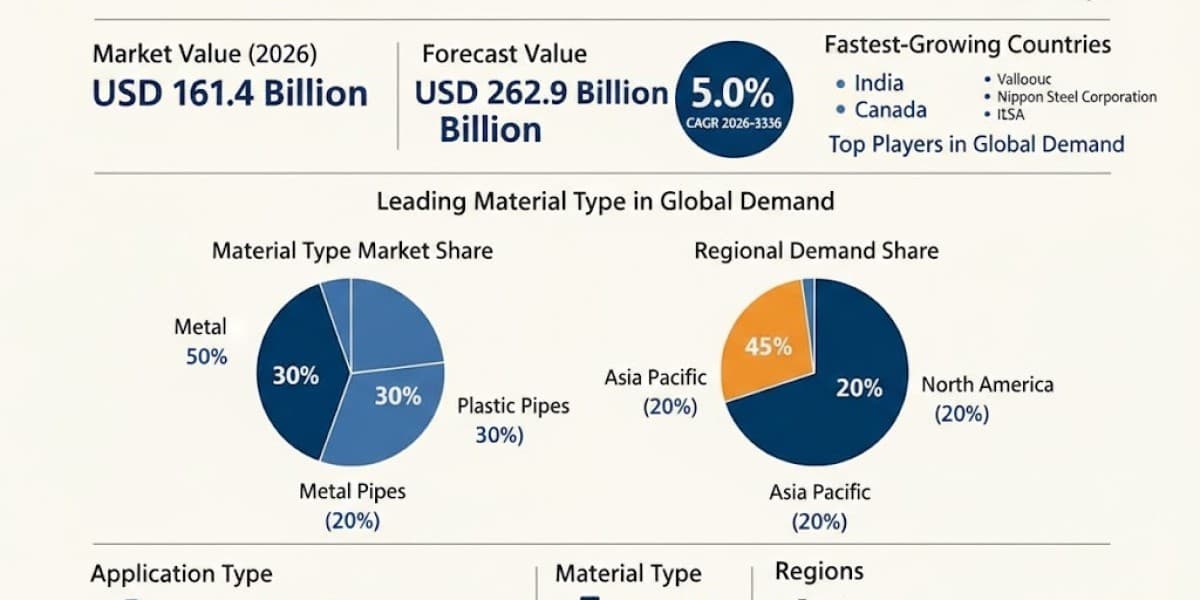
<p>The global <a href="https://www.futuremarketinsights.com/reports/pipes-market">pipe market</a> is entering a phase of steady, infrastructure-led growth as governments and industries prioritize long-term investments in water, energy, and industrial transport systems. According to the latest analysis, the market is valued at <strong>USD 161.4 billion in 2026</strong> and is projected to reach <strong>USD 262.9 billion by 2036</strong>, expanding at a <strong>CAGR of 5.0%</strong>. The sector is expected to generate an <strong>incremental opportunity of USD 101.5 billion</strong> over the forecast period.</p><p>This growth reflects a structural shift toward <strong>asset replacement, network modernization, and high-performance material adoption</strong>, where pipes serve as critical enablers of utility resilience, industrial efficiency, and energy security.</p><p><strong>Get detailed market forecasts, competitive benchmarking, and pricing trends: </strong><a href="https://www.futuremarketinsights.com/reports/sample/rep-gb-14917">https://www.futuremarketinsights.com/reports/sample/rep-gb-14917</a></p><p><strong>Featured Snippet: Key Market Answer</strong></p><p><strong>Q: What is driving the growth of the pipe market?</strong></p><p><strong>A:</strong> Growth is driven by infrastructure expansion, replacement of aging pipelines, rising energy transmission needs, and increasing demand for durable, high-performance piping systems across water, oil & gas, and industrial applications.</p><p><strong>Quick Stats</strong></p><ul><li><strong>Market Size (2026):</strong> USD 161.4 billion</li><li><strong>Forecast (2036):</strong> USD 262.9 billion</li><li><strong>CAGR (2026–2036):</strong> 5.0%</li><li><strong>Incremental Opportunity:</strong> USD 101.5 billion</li><li><strong>Leading Material Segment:</strong> Metal Pipes (67.7%)</li><li><strong>Leading End-Use Industry:</strong> Oil & Gas (38.0%)</li></ul><p><strong>Market Overview: Infrastructure Backbone Driving Long-Term Demand</strong></p><p>The pipe market represents a <strong>foundational layer of global infrastructure</strong>, enabling the transport of water, gas, chemicals, and industrial fluids across diverse sectors. Demand is increasingly shaped by:</p><ul><li><strong>Aging infrastructure replacement cycles</strong></li><li><strong>Urbanization and utility expansion</strong></li><li><strong>Energy transition and pipeline investments</strong></li><li><strong>Industrial capacity growth</strong></li></ul><p>Unlike cyclical construction markets, pipe demand is <strong>anchored in essential services</strong>, ensuring stable and predictable growth patterns. High-value segments such as <strong>large-diameter and high-specification pipes</strong> dominate due to stringent regulatory and operational requirements.</p><p><strong>Key Growth Drivers</strong></p><ol><li><strong>Infrastructure Expansion and Urbanization</strong></li></ol><p>Rapid urban development is increasing demand for <strong>municipal water supply, sewage systems, and district energy networks</strong>, driving large-scale pipe installations globally.</p><ol start="2"><li><strong>Energy Sector Dominance</strong></li></ol><p>The <strong>oil & gas sector (38.0% share)</strong> remains the largest consumer, requiring extensive pipeline networks for <strong>exploration, transportation, and refining operations</strong>.</p><ol start="3"><li><strong>Aging Pipeline Replacement</strong></li></ol><p>Developed economies are investing heavily in <strong>rehabilitation and replacement of aging infrastructure</strong>, ensuring long-term demand stability.</p><ol start="4"><li><strong>Industrial and Process Demand</strong></li></ol><p>Industries such as <strong>chemicals, manufacturing, and power generation</strong> rely on high-performance piping systems capable of withstanding <strong>extreme pressure, temperature, and corrosion</strong>.</p><p><strong>Market Trends Shaping the Industry</strong></p><ul><li><strong>Shift Toward High-Specification Materials:</strong> Increasing use of steel and alloy pipes for critical applications</li><li><strong>Lifecycle Cost Optimization:</strong> Preference for durable, low-maintenance piping systems</li><li><strong>Sustainability and Compliance:</strong> Adoption of corrosion-resistant and environmentally compliant materials</li><li><strong>Growth in Utility Modernization:</strong> Rising investment in smart and efficient pipeline systems</li><li><strong>Material Diversification:</strong> Increased use of plastic and composite pipes in targeted applications</li></ul><p><strong>Segment Insights</strong></p><p><strong>Material Leadership: Metal Pipes (67.7%)</strong></p><p>Metal pipes dominate the market due to:</p><ul><li>High strength and pressure tolerance</li><li>Suitability for high-temperature and corrosive environments</li><li>Compliance with stringent industrial and safety standards</li></ul><p>Plastic and composite pipes are gaining traction in applications requiring <strong>lightweight and corrosion-resistant solutions</strong>.</p><p><strong>End-Use Leadership: Oil & Gas (38.0%)</strong></p><p>The oil & gas industry leads demand due to:</p><ul><li>Extensive pipeline infrastructure requirements</li><li>High safety and reliability standards</li><li>Continuous operation across upstream, midstream, and downstream segments</li></ul><p>Other key sectors include <strong>water & wastewater, construction, and industrial processing</strong>.</p><p><strong>Regional Insights</strong></p><p><strong>Top Growth Markets (CAGR 2026–2036)</strong></p><ul><li><strong>India: 8.3%</strong> – Driven by water infrastructure, irrigation, and gas distribution expansion</li><li><strong>China: 7.8%</strong> – Supported by municipal projects and industrial demand</li><li><strong>Canada: 6.6%</strong> – Infrastructure renewal and energy sector investments</li><li><strong>Italy: 6.4%</strong> – Urban redevelopment and regulatory upgrades</li><li><strong>USA: 5.9%</strong> – Aging infrastructure replacement and energy projects</li></ul><p><strong>Emerging Market Outlook</strong></p><ul><li><strong>Asia-Pacific</strong> leads in overall demand growth due to rapid urbanization and industrialization</li><li><strong>India and China</strong> are key growth engines, supported by large-scale infrastructure programs</li><li>Developed regions focus on <strong>replacement and modernization rather than new installations</strong></li></ul><p><strong>Competitive Landscape</strong></p><p>The pipe market is <strong>moderately consolidated</strong>, with competition increasingly focused on <strong>performance, compliance, and global supply capabilities</strong>.</p><p><strong>Key Players</strong></p><ul><li>Tenaris</li><li>Vallourec</li><li>Nippon Steel & Sumitomo Metal</li><li>TMK Group</li></ul>