Renewable Polyol Market Growth Accelerates as Construction and Furniture Sectors Shift Toward Low-Carbon Materials
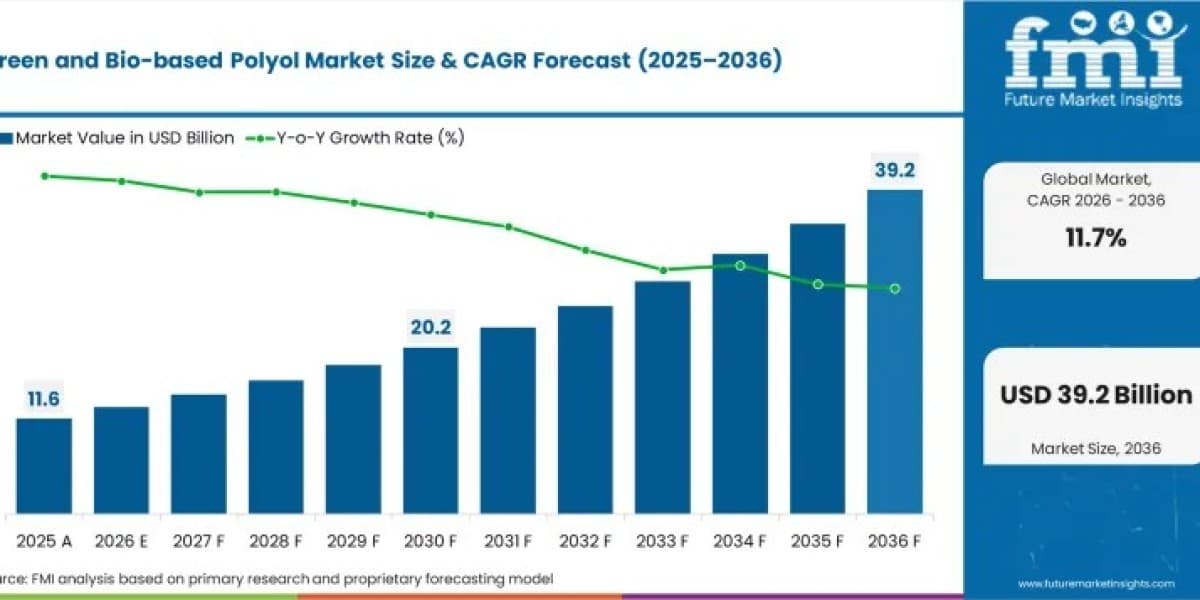
<p>According to the latest market analysis by Future Market Insights (FMI), the global <a href="Request%20for%20Sample%20-%20https:/www.futuremarketinsights.com/reports/bio-polyol-green-polyol-market">Green and Bio-based Polyol Market</a> is entering a rapid expansion phase as construction companies, automotive manufacturers, furniture producers, and polyurethane foam suppliers increasingly prioritize renewable feedstocks, lower-carbon materials, and sustainable polyurethane solutions across insulation, seating, coatings, and cushioning applications.</p><p>The market, valued at USD 11.6 billion in 2025, is projected to reach USD 13.0 billion in 2026 and further expand to USD 39.2 billion by 2036, registering a CAGR of 11.7% during the forecast period. Growth is being driven by rising adoption of renewable polyurethane feedstocks, increasing demand for low-carbon insulation materials, expanding automotive seating applications, and stronger sustainability commitments across global manufacturing industries.</p><p><strong>Request for a Sample: <a href="https://www.futuremarketinsights.com/reports/sample/rep-gb-273">https://www.futuremarketinsights.com/reports/sample/rep-gb-273</a> </strong></p><p>Green and bio-based polyols are increasingly evolving from niche polyurethane additives into strategic low-carbon material solutions capable of supporting sustainable construction, energy-efficient insulation systems, renewable automotive interiors, and environmentally responsible foam production across global markets.</p><p><strong>Summary of Green and Bio-based Polyol Market</strong></p><ul><li>Market Size (2025): USD 11.6 Billion<br />• Market Size (2026): USD 13.0 Billion<br />• Market Size (2036): USD 39.2 Billion<br />• Growth Rate: 11.7% CAGR (2026–2036)<br />• Leading Source Segment: Plant-based Polyols (70.0% share)<br />• Leading Product Segment: Polyether Polyols (55.0% share)<br />• Leading Application Segment: Polyurethane Foams (60.0% share)<br />• Leading End-use Segment: Construction Industry (50.0% share)<br />• Leading Distribution Channel: Direct Sales (65.0% share)<br />• Fastest Growing Markets: India (17.8% CAGR) and Germany (12.3% CAGR)<br />• Key Players: BASF SE, Dow Inc., Covestro AG, Huntsman Corporation, Cargill Incorporated, Emery Oleochemicals</li></ul><p><strong>Rising Demand for Low-Carbon Polyurethane Solutions Driving Market Expansion</strong></p><p>The green and bio-based polyol market is witnessing strong momentum as polyurethane manufacturers, insulation suppliers, and automotive component producers increasingly adopt renewable and recycled feedstock solutions to reduce fossil-carbon exposure while maintaining existing foam processing performance.</p><p>Industry stakeholders are increasingly prioritizing:</p><ul><li>Expansion of renewable polyurethane feedstock adoption<br />• Development of lower-carbon insulation and cushioning materials<br />• Improved sustainability and carbon-footprint reporting across supply chains<br />• Increased use of plant-based polyols in furniture and bedding applications<br />• Enhanced traceability and certified mass-balance feedstock systems</li></ul><p>This transition reflects broader industry demand for sustainable materials capable of supporting carbon-reduction goals, regulatory compliance, and environmentally responsible manufacturing across construction, automotive, and industrial sectors.</p><p><strong>Product and Segment Trends</strong></p><p>Market segmentation highlights strong demand across polyurethane and insulation applications:</p><ul><li>Plant-based Polyols (70.0%) dominate the source segment due to growing use of soybean oil, castor oil, and vegetable oil derivatives<br />• Polyether Polyols (55.0%) lead the product segment owing to broad use in flexible foam systems and automotive seating applications<br />• Polyurethane Foams (60.0%) remain the leading application segment because of strong insulation and cushioning demand<br />• Construction Industry (50.0%) continues leading end-use demand through rigid foam insulation and commercial construction projects<br />• Direct Sales (65.0%) dominate distribution channels as large foam manufacturers require technical support and long-term supply contracts</li></ul><p>Green and bio-based polyols are increasingly becoming essential materials for modern insulation systems, flexible foam production, automotive interiors, and sustainable polyurethane manufacturing worldwide.</p><p><strong>Access Full Report: <a href="https://www.futuremarketinsights.com/reports/bio-polyol-green-polyol-market">https://www.futuremarketinsights.com/reports/bio-polyol-green-polyol-market</a> </strong></p><p> <strong>Technology Advancements and Certified Supply Chains Accelerating Adoption</strong></p><p>Manufacturers and chemical suppliers are increasingly focusing on:</p><ul><li>Development of certified biomass-balance polyether polyols<br />• Expansion of renewable feedstock sourcing and recycled carbon streams<br />• Improved foam performance consistency and aging behavior validation<br />• Enhanced ISCC PLUS-certified production infrastructure<br />• Advanced feedstock traceability and sustainability documentation systems</li></ul><p>The market is witnessing increased investment in sustainable polyurethane infrastructure, including:</p><ul><li>Expansion of bio-based polyol production facilities<br />• Greater certification of renewable and circular feedstock supply chains<br />• Increased focus on recycled polyurethane and waste-based polyol technologies<br />• Strengthening of direct supplier relationships with foam manufacturers<br />• Modernization of lower-carbon construction and automotive material systems</li></ul><p>These strategies are helping buyers improve sustainability performance, regulatory alignment, and renewable content verification while maintaining established polyurethane processing systems.</p><p><strong>Regional Outlook and Growth Opportunities</strong></p><p>The market demonstrates strong regional growth dynamics:</p><ul><li>India (17.8% CAGR): Expanding bio-based chemical production and strong construction foam demand supporting rapid growth<br />• Germany (12.3% CAGR): Rising insulation standards and renewable material adoption accelerating demand<br />• Italy (12.0% CAGR): Furniture foam and coatings manufacturers expanding renewable polyol qualification programs<br />• China (11.6% CAGR): Large-scale polyurethane manufacturing and automotive seating demand supporting adoption<br />• France (11.0% CAGR): Growing focus on building energy efficiency and low-carbon insulation materials strengthening demand<br />• United Kingdom (10.5% CAGR): Construction retrofit projects and sustainable furniture manufacturing supporting market expansion<br />• United States (9.4% CAGR): Certified mass-balance production systems and automotive foam programs fueling growth</li></ul><p>The global green and bio-based polyol market remains a critical sustainable materials category as governments, construction companies, automotive suppliers, and polyurethane manufacturers increasingly prioritize renewable feedstocks, lower-carbon materials, and verified sustainability performance.</p><p><strong>Competitive Landscape and Strategic Positioning</strong></p><p>Leading market participants are increasingly focusing on certified renewable feedstock systems, foam qualification support, and sustainable polyurethane innovation to strengthen their market position.</p><p>Key competitive strategies include:</p><ul><li>Expansion of ISCC PLUS-certified manufacturing assets<br />• Strengthening renewable and recycled feedstock supply capabilities<br />• Increasing investment in biomass-balance polyurethane systems<br />• Development of lower-carbon coatings, adhesives, and foam materials<br />• Enhancement of customer-specific technical and formulation support services</li></ul><p>In January 2024, Dow Inc. received ISCC PLUS certification coverage for PO/PG and polyols manufacturing at its Freeport facility in Texas. In November 2024, Covestro AG expanded production of partially bio-based coating raw materials at its Foshan facility in China. In March 2026, BASF SE launched commercial biomass-balance polyether polyol production in North America at its Geismar site.</p><p><strong>About Future Market Insights (FMI)</strong></p><p><a href="https://www.futuremarketinsights.com?utm_source=chatgpt.com">Future Market Insights (FMI)</a> is a leading provider of market intelligence and consulting services, serving clients in over 150 countries. Headquartered in Delaware, USA, with a global delivery center in India and offices in the UK and UAE, FMI delivers actionable insights to businesses across industries including chemicals, advanced materials, healthcare, industrial manufacturing, and sustainable technologies.</p><p><strong>For Press & Corporate Inquiries</strong></p><p>Rahul Singh<br />AVP - Marketing and Growth Strategy<br />Future Market Insights, Inc.</p><p>+91 8600020075</p><p>For Sales – <a href="mailto:sales@futuremarketinsights.com">sales@futuremarketinsights.com</a> <br />For Media – <a href="mailto:Rahul.singh@futuremarketinsights.com">Rahul.singh@futuremarketinsights.com</a></p><p> </p>