Temporary Fencing Panels Market Growth to USD 5,307.3 million by 2035
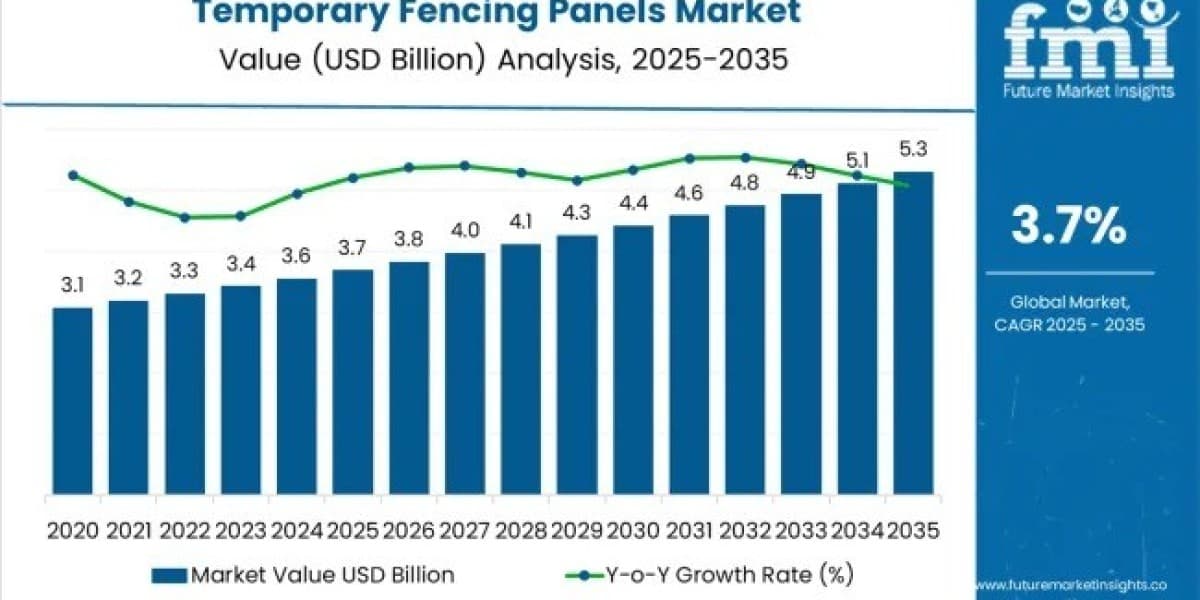
<p>The global <a href="https://www.futuremarketinsights.com/reports/temporary-fencing-panels-market-share-analysis">temporary fencing panels market</a> is projected to reach <strong>USD 5,307.3 million by 2035</strong>, growing at a <strong>CAGR of 3.7%</strong>. Increasing reliance on <strong>cost-effective, lightweight, and transportable fencing solutions</strong> for <strong>construction, events, and industrial safety</strong> continues to fuel demand across multiple sectors. As public safety, crowd control, and site compliance remain top priorities, both <strong>established brands and emerging manufacturers</strong> are ramping up innovation to capture growing market potential.</p><p><strong><em>Subscribe for Year-Round Insights → </em>Stay ahead with quarterly and annual data updates </strong><a href="https://www.futuremarketinsights.com/reports/sample/rep-gb-20500">https://www.futuremarketinsights.com/reports/sample/rep-gb-20500</a></p><p><strong>Market Overview: Growth Fueled by Safety and Versatility</strong></p><p>Temporary fencing panels have become indispensable in modern infrastructure and event management projects due to their <strong>mobility, durability, and easy installation</strong>. The <strong>construction sector</strong> continues to lead the market, representing <strong>45% of the total demand</strong>, followed closely by large-scale public events and industrial zones requiring safety barriers and restricted access.</p><p>The market remains <strong>moderately fragmented</strong>, with top-tier players such as <strong>Heras, Betafence, and Fortress Fencing</strong> collectively holding <strong>35% of the global share</strong>. These leaders dominate through their robust design capabilities, large-scale distribution networks, and emphasis on <strong>high-quality materials</strong> such as <strong>corrosion-resistant steel and mesh</strong>.</p><p><strong>Product Landscape: Standard Panels Lead, Anti-Climb Solutions Gain Momentum</strong></p><p><strong>Standard fencing panels</strong> account for nearly <strong>40% of global market share</strong>, owing to their affordability and broad applicability. They serve as the preferred choice for <strong>construction sites, public gatherings, and residential projects</strong>. However, the <strong>anti-climb fencing segment</strong> is witnessing rising traction—particularly in <strong>industrial and high-security environments</strong> where enhanced protection is vital.</p><p><strong>Heras and Betafence</strong> lead the standard fencing segment, focusing on lightweight, easily assembled panels that provide superior mobility. Meanwhile, <strong>Fortress Fencing</strong> is advancing anti-climb solutions designed for industrial and hazardous zones, offering reinforced structures that prevent unauthorized access. <strong>Jacksons Fencing</strong> complements this with heavy-duty panels suited for long-term deployment in demanding conditions.</p><p><strong>Competitive Landscape: Established Leaders and Emerging Innovators</strong></p><p>The industry is seeing <strong>dynamic collaboration between global and regional manufacturers</strong>. Major players continue to invest in <strong>technological upgrades</strong>, while <strong>new entrants</strong> are carving out regional niches with <strong>affordable, modular, and eco-friendly solutions</strong>.</p><p><strong>Heras</strong>, a long-standing market leader, has built its reputation on <strong>lightweight modular fencing panels</strong> ideal for temporary use in construction and events. Its strong <strong>European distribution partnerships</strong> enable rapid delivery and customer support, while its <strong>flexible rental options</strong> make it a go-to provider for temporary infrastructure needs.</p><p><strong>Betafence</strong> has cemented its place in the <strong>high-security fencing</strong> segment with cutting-edge <strong>anti-climb and tamper-resistant solutions</strong>. With advanced mesh technologies and reinforced frames, Betafence ensures superior protection across <strong>industrial, military, and government sites</strong>. Its blend of <strong>durability and aesthetic design</strong> makes it a preferred choice for urban applications where security and appearance go hand in hand.</p><p><strong>Fortress Fencing</strong>, known for its <strong>sustainability-driven innovation</strong>, integrates recycled materials into its production process. Its <strong>customized, high-strength fencing systems</strong> are designed to meet the exact requirements of diverse clients, from industrial perimeters to event venues. This focus on personalization and environmental responsibility has positioned Fortress as a frontrunner in <strong>eco-conscious security solutions</strong>.</p><p><strong>Emerging Trends and Future Roadmap</strong></p><p>The <strong>temporary fencing panels market</strong> is poised for transformation through <strong>sustainable manufacturing, modular scalability, and digital integration</strong>. Manufacturers are moving toward <strong>eco-friendly materials</strong> and <strong>smart assembly systems</strong> that reduce installation time and improve reusability.</p><p>Expansion into <strong>Asia-Pacific and Latin American markets</strong> presents significant opportunities, driven by <strong>rapid urbanization and infrastructure investments</strong>. Companies are forming <strong>strategic partnerships</strong> to enhance distribution capabilities, streamline supply chains, and meet rising regional demand.</p><p>The <strong>next decade</strong> will see growth shaped by <strong>innovation, sustainability, and adaptability</strong>. Firms that embrace lightweight materials, modular engineering, and environmentally responsible practices will not only capture new markets but also redefine industry standards in safety and mobility.</p>