The Role of Intent Annotation in Training Smarter Conversational AI Systems
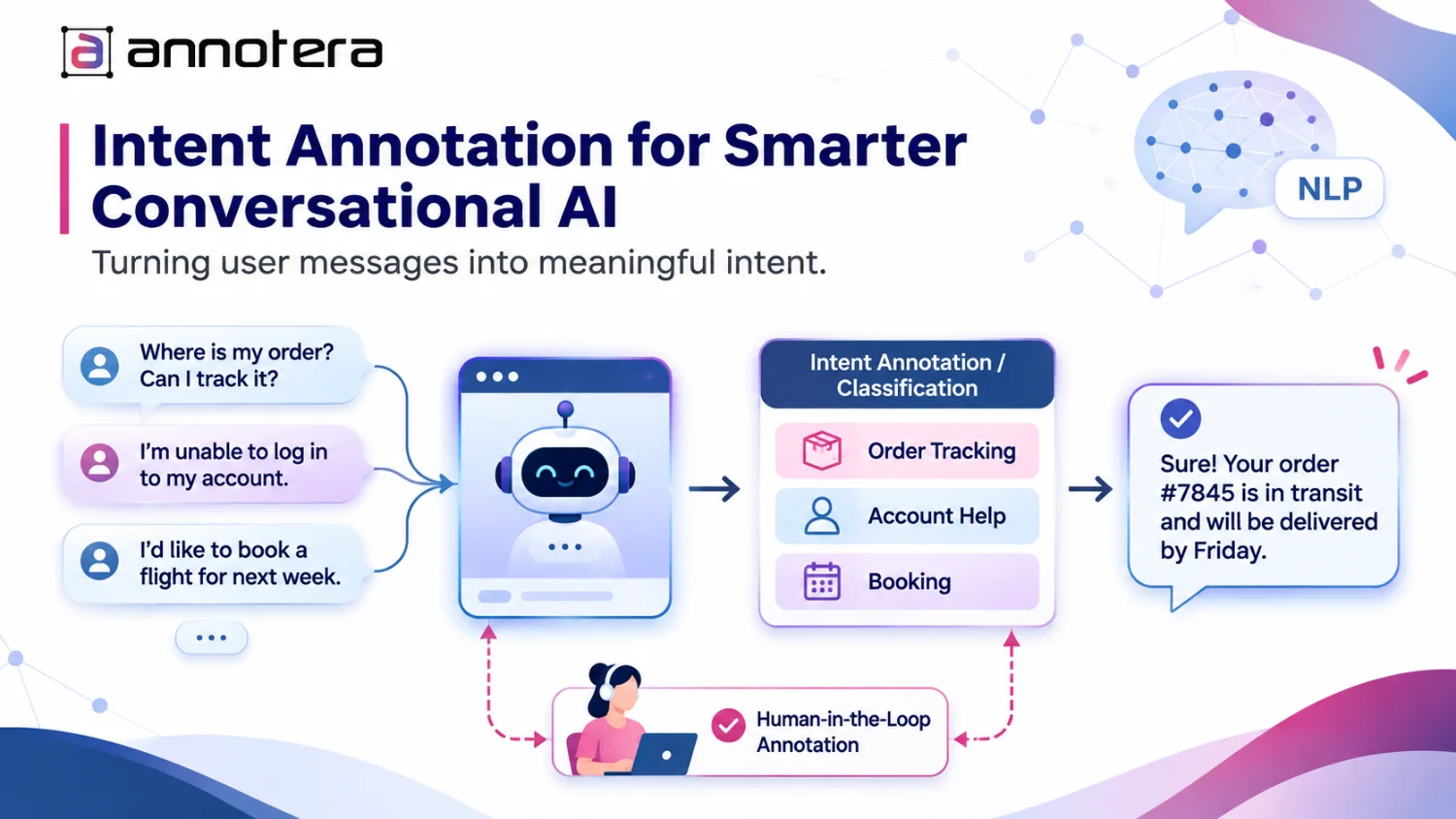
Conversational AI systems are transforming how businesses interact with customers. From intelligent chatbots and virtual assistants to automated customer support platforms, these systems are expected to understand user queries, interpret context, and deliver relevant responses. However, their effectiveness depends on more than sophisticated algorithms or large language models. They need high-quality training data that accurately represents how people communicate. This is where intent annotation becomes essential.
Intent annotation helps AI models understand what users actually want when they communicate through text. By assigning meaningful labels to user queries, organizations can train conversational AI systems to recognize requests, identify underlying objectives, and respond appropriately. With reliable intent classification datasets, businesses can develop smarter, more responsive, and context-aware conversational experiences.
What Is Intent Annotation in Conversational AI?
Intent annotation is the process of identifying and labeling the purpose behind a user's message. Rather than simply recognizing individual words, it helps AI systems understand the action, information, or assistance a user expects.
For example, consider these customer queries:
"I want to check my delivery status."
"Where is my package?"
"Has my order been shipped?"
Although the wording differs, all three messages communicate the same intent: Order Tracking.
Human annotators assign consistent labels to such queries, allowing machine learning models to recognize different expressions of the same underlying request. These labeled examples become training datasets that help conversational AI understand natural language more effectively.
Why Intent Annotation Matters for Conversational AI Systems
Conversational AI must interpret user expectations accurately to deliver meaningful interactions. Without properly annotated training data, even advanced NLP models may struggle with ambiguous queries, unfamiliar expressions, and variations in conversational language.
Here are some important ways intent annotation improves conversational AI performance.
- Improves Intent Recognition and Classification Accuracy
One of the primary benefits of intent annotation is improved intent recognition. Users rarely communicate using identical sentence structures. They may express the same requirement through formal language, informal phrases, abbreviations, or incomplete sentences.
For example, a user asking "Can you help me reset my password?" and another saying "I forgot my login password" are expressing a similar intent.
Accurately labeled datasets help models learn these linguistic variations. Through effective intent classification, conversational AI can identify the user's objective even when the exact words differ from its training examples.
- Enables More Context-Aware Conversations
Understanding individual messages is not always sufficient. Conversational AI must also interpret the context of ongoing interactions.
Consider a conversation:
User: "I need to change my booking."
AI: "Would you like to change the date or destination?"
User: "The date, please."
The final response depends on understanding the preceding conversation. Annotating multi-turn interactions with contextual intent labels helps AI systems recognize follow-up requests, maintain conversational continuity, and avoid treating every message as an isolated query.
This is particularly valuable for virtual assistants, banking chatbots, travel platforms, and customer support applications.
- Reduces Misinterpretation and Irrelevant Responses
Incorrect intent recognition can result in irrelevant answers, repeated questions, and frustrating customer experiences.
For instance, a customer asking "I want to cancel my subscription" should not receive instructions about purchasing a new subscription.
Intent annotation helps establish clear distinctions between similar but different user objectives. Annotators can also identify ambiguous queries and assign appropriate labels based on defined annotation guidelines.
As a result, conversational AI systems become better equipped to understand customer expectations and direct requests toward the correct workflows.
- Supports Multilingual and Industry-Specific AI Applications
Businesses increasingly deploy conversational AI across different languages, regions, and industries. However, user intent can vary significantly depending on cultural expressions, terminology, and communication styles.
A banking chatbot, for example, must distinguish between balance inquiries, fund transfers, loan applications, and transaction disputes. Similarly, an e-commerce assistant needs to recognize product inquiries, payment issues, order cancellations, and return requests.
High-quality intent annotation helps create domain-specific datasets that reflect these requirements. Multilingual annotation further enables AI systems to recognize equivalent intents across languages while accounting for regional vocabulary and expressions.
Key Steps Involved in Building High-Quality Intent Annotation Datasets
Developing reliable intent datasets requires a structured annotation process. Each stage contributes to the accuracy and consistency of conversational AI training.
-
Define an Intent Taxonomy: Establish a clear classification framework covering primary intents, sub-intents, and relevant categories. Labels should be distinct, meaningful, and aligned with the application's objectives.
-
Collect Diverse Conversational Data: Gather representative user queries from customer support interactions, chatbot conversations, FAQs, and other relevant text sources. Include different sentence structures, spelling variations, and informal expressions.
-
Apply Consistent Intent Labels: Trained annotators assign predefined labels to each message using documented annotation guidelines. Consistency is essential to prevent conflicting interpretations.
-
Handle Ambiguous and Unseen Queries: Not every message will fit an existing category. Annotators should identify unclear requests, overlapping intents, and out-of-scope queries instead of forcing inaccurate labels.
-
Conduct Quality Assurance: Review annotated datasets through validation checks, sampling, inter-annotator agreement assessments, and expert review. Correct inconsistencies before using the data for model training.
Common Challenges in Intent Annotation
Despite its importance, intent annotation presents several challenges that can affect dataset quality.
Overlapping intents: Similar expressions may communicate different objectives depending on context.
Ambiguous queries: Short messages such as "I need help" provide limited information about user intent.
Evolving language: Slang, abbreviations, emerging expressions, and changing customer expectations require continuous dataset updates.
Class imbalance: Frequently occurring intents may dominate training datasets, while less common but important requests receive insufficient representation.
Annotation inconsistency: Different annotators may interpret the same message differently without clear guidelines and quality controls.
Addressing these challenges requires a combination of domain expertise, structured annotation workflows, and continuous quality monitoring.
How Annotera Helps Build Better Intent Annotation Datasets
Building smarter conversational AI requires training data that reflects real-world communication patterns. Annotera supports organizations in developing high-quality text datasets through structured annotation workflows, trained human annotators, and multi-level quality assurance.
As an experienced text annotation company, Annotera understands the importance of accurate labeling, contextual interpretation, and consistent annotation standards. Its text annotation capabilities help AI teams prepare datasets for chatbots, virtual assistants, NLP applications, and other language-driven technologies.
Organizations looking to scale their data preparation workflows can leverage text annotation outsourcing services to access skilled annotation resources, improve labeling consistency, and manage growing dataset requirements.
From intent identification and query categorization to handling complex conversational data, Annotera focuses on delivering reliable annotations that support effective model training and evaluation.
Conclusion
Intent annotation is a fundamental component of building intelligent conversational AI systems. It enables models to move beyond keyword recognition and understand the underlying purpose of user communication. Accurate labels, diverse training examples, contextual understanding, and rigorous quality assurance collectively contribute to better intent classification and more meaningful AI interactions.
As conversational AI continues to evolve, businesses must prioritize the quality of their training datasets. Partnering with a reliable annotation provider like Annotera can help organizations develop structured, scalable, and high-quality datasets that support smarter conversational experiences.
Ready to improve your conversational AI performance? Partner with Annotera for reliable text annotation solutions and build intent-aware datasets that help your AI systems understand users better. Visit www.annotera.ai to explore our annotation capabilities.